For distributors, copier service companies, and procurement managers, the choice of a wholesale toner supplier directly impacts inventory turnover, customer satisfaction, and operational costs. Unlike retail purchases, wholesale buying involves long-term commitments, batch consistency, and reliable logistics. A single defective shipment can trigger returns, service calls, and reputational damage. This article outlines measurable criteria to evaluate a wholesale compatible toner supplier without marketing exaggeration.
Why the Supplier Choice Matters Beyond Price
Many buyers focus primarily on unit cost. However, hidden costs from poor quality – re-shipments, printer downtime, chip failures, and customer churn – often exceed the initial savings. A professional wholesale toner partner provides predictable page yields, consistent print density, and stable chip firmware across thousands of cartridges. In B2B printing fleets, even a 2% defect rate translates into significant operational friction.
Core Criteria for Evaluating a Wholesale Toner Supplier
The following parameters help procurement teams compare suppliers objectively. Each criterion should be verified through samples, documentation, and, if possible, a trial order.
Compatibility and Chip Firmware Stability
Compatible toner cartridges must match OEM specifications for printer models. However, compatibility is not binary. Chip firmware updates from printer manufacturers can disable non-OEM cartridges overnight. A reliable wholesale toner supplier monitors OEM firmware releases and updates their chip programming accordingly. Ask the supplier:
- How often do you test against new printer firmware?
- Do you provide chip version tracking per batch?
- What is your response time for chip-related failure claims?
Batch-to-batch chip consistency matters equally. Some suppliers mix older and newer chip revisions in the same shipment, leading to intermittent recognition errors. Request a chip compatibility statement for each SKU before placing large orders.
Print Quality and Density
Print quality for wholesale toner should be evaluated using standardized test pages, not subjective opinion. Key metrics include:
Optical density (OD) – A value above 1.3 for black text on plain paper indicates sufficient toner laydown.
Backgrounding (veiling) – Excess toner particles outside the character area suggest poor charge control.
Fusing stability – Toner should not smear or flake off when rubbed immediately after printing.
Halftone uniformity – No visible bands, streaks, or granular patterns.
Request a print sample kit that includes full-page coverage, grayscale gradients, and fine line patterns. Compare these against OEM originals under the same printer conditions. Any deviation should be documented and discussed with the supplier.
Page Yield Consistency
Page yield is the number of printed pages a cartridge delivers before running out of toner. Wholesale buyers need yield that matches specifications within a narrow tolerance (typically +/- 5%). Inconsistent yield erodes fleet cost-per-page calculations and leads to unexpected replacement cycles.
Ask the wholesale toner supplier for yield test reports based on ISO/IEC 19752 (for monochrome) or ISO/IEC 19798 (for color). These standards define test page coverage and methodology. Beware of suppliers who only provide “estimated” yields without referenced test conditions.
Batch-to-Batch Consistency
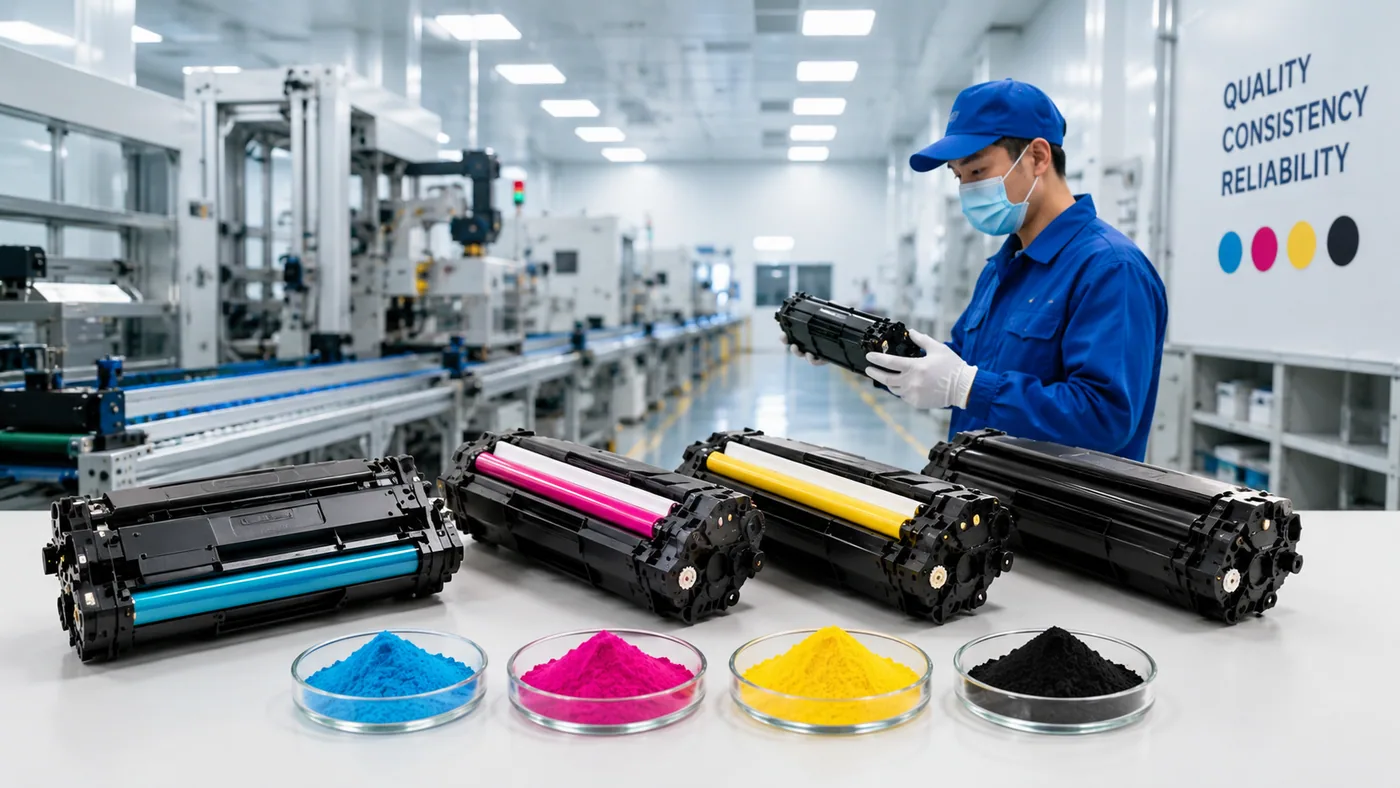
A single good batch proves little. Wholesale purchasing requires that batch #101 and batch #203 perform identically. Inconsistent toner flow, changed chip suppliers, or varying cartridge assembly can create invisible differences that only appear after thousands of prints.
To assess batch consistency:
Request certificates of analysis (CoA) for three different production months.
Ask about incoming component quality control – are chips, wiper blades, and toner powder sourced from approved suppliers with change control?
Inquire about shelf-life testing: does the supplier store cartridges for 12–24 months and retest performance?
Distributors who skip this step often discover that subsequent orders produce more frequent jams or lighter prints, forcing costly customer support.
Packaging and Logistics for Wholesale Shipments
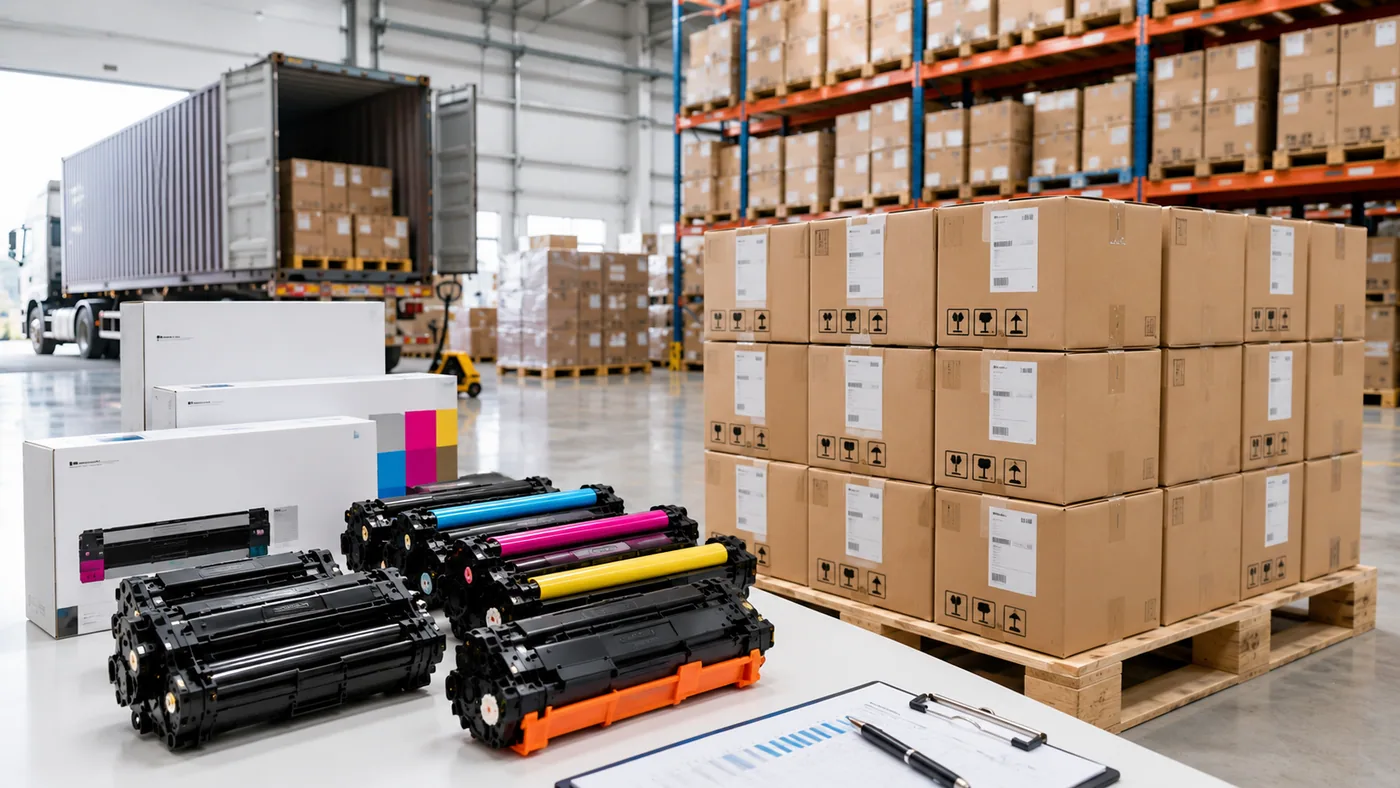
Compatible toner cartridges are sensitive to shock, temperature fluctuations, and humidity during transit. Wholesale packaging must protect individual cartridges while optimizing pallet density. Evaluate:
Individual cartridge bags – anti-static and sealed against dust.
Inner boxes – corrugated cardboard with sufficient crush resistance.
Master carton labeling – includes batch number, production date, and compatible printer models.
Pallet wrapping – stretch film and corner protectors for sea or rail freight.
Ask about the supplier’s damage rate per 10,000 cartridges. A responsible wholesale toner partner will share internal claims data. Also confirm which Incoterms they support (EXW, FOB, CIF) and their typical lead time for restocking.
Minimum Order Quantities (MOQ) and Supply Stability
Wholesale toner suppliers define MOQ per SKU, often ranging from 100 to 500 pieces for standard cartridges, and higher for color or high-yield units. MOQ should match your inventory turnover without forcing excessive storage. More importantly, assess supply stability:
- Does the supplier hold safety stock for popular SKUs?
- What is their average lead time for reorders?
- Do they have component shortages (chips, OPC drums) that disrupt production?
Request a supply commitment letter or a history of on-time deliveries over six months. Avoid suppliers who frequently change MOQ or request premium payments for urgent restocks.
Private Label Options
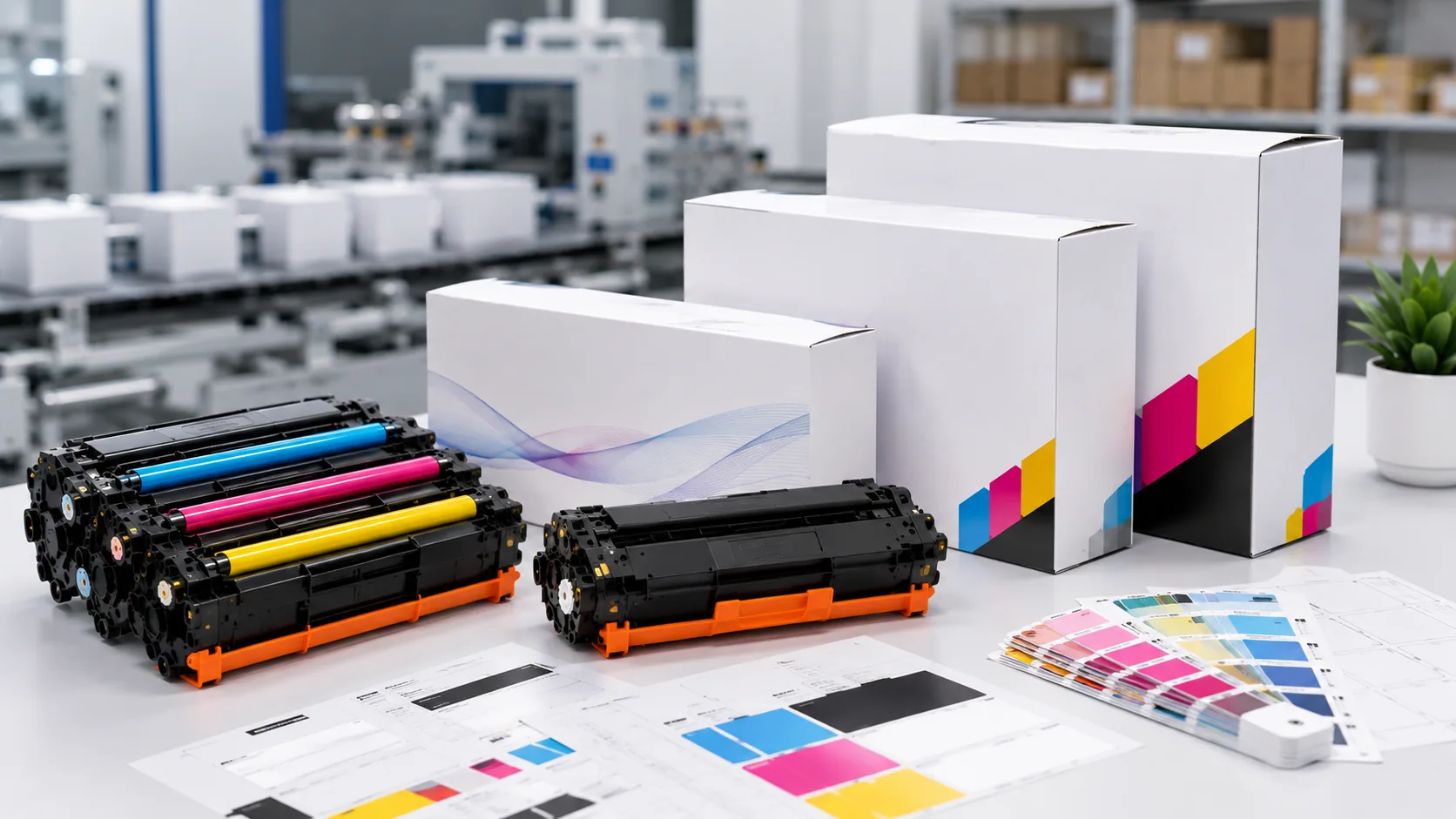
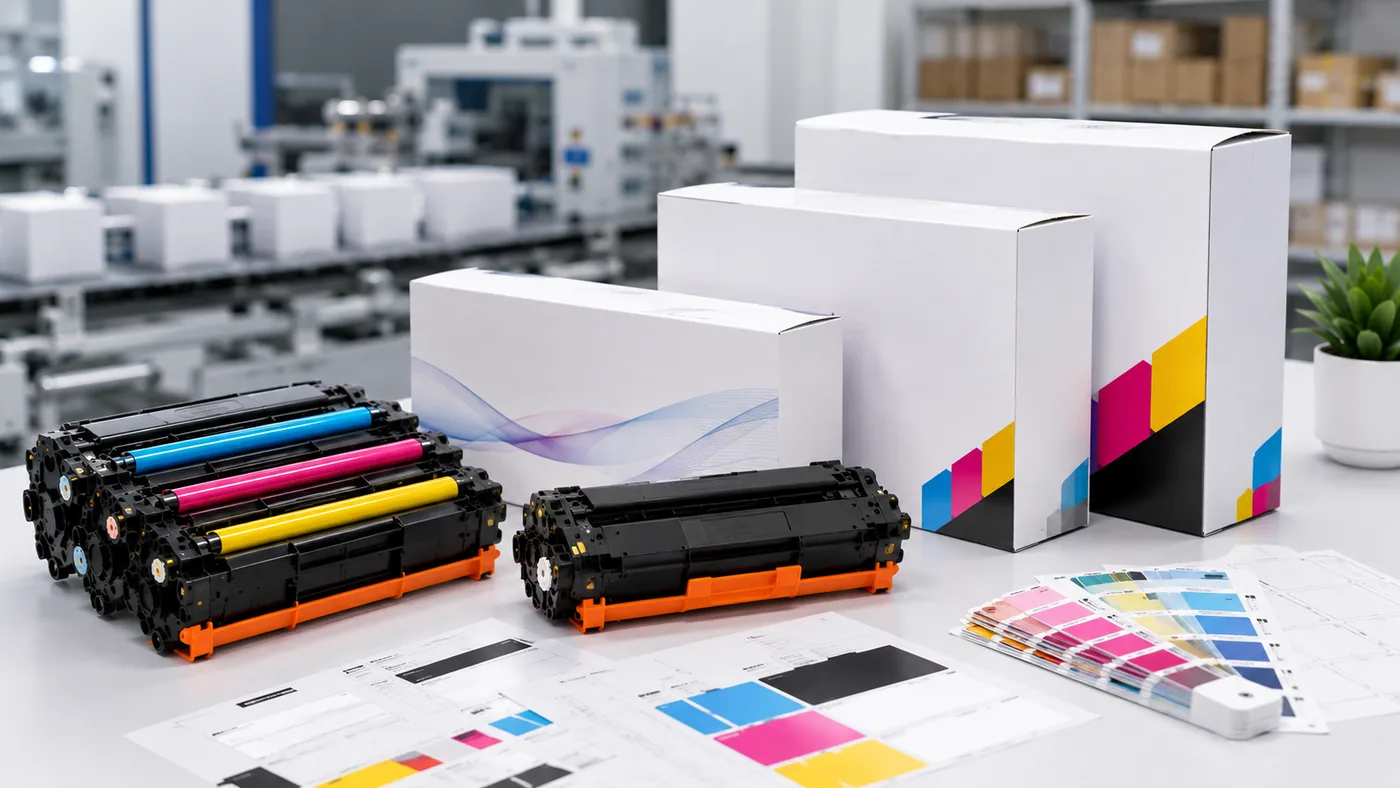
Many wholesale buyers require private label packaging – their own brand on boxes and cartridges. Private label toner adds value and customer loyalty but demands additional supplier capabilities:
- Box design and printing coordination
- Custom cartridge labeling (tamper-evident stickers or direct printing)
- Minimum run quantities for custom packaging (usually 1,000–3,000 pieces per SKU)
- Separate SKU management to avoid mixing with unbranded stock
A competent wholesale toner supplier will provide a private label checklist and a sample of their previous work. They should also handle customs documentation that reflects your brand if shipping cross-border.
Red Flags to Avoid
Even established suppliers can present risks. Watch for these warning signals:
No test reports or unwillingness to share ISO yield data.
Vague batch traceability – cartridges without lot numbers or production dates.
Frequent chip compatibility complaints from other clients (search industry forums or ask for references).
Inconsistent communication – slow technical responses or changing account managers.
Reluctance to provide a sample order before large commitments.
When to Request a Sample or a Quote
Professional procurement for wholesale toner involves a structured validation process:
Initial inquiry – request a product catalog, MOQ, and lead time.
Sample request – order 5–10 cartridges of your most critical SKUs.
In-house testing – run print quality, yield, and chip compatibility tests (keep detailed logs).
Batch consistency check – order a second sample from a different production month.
Small pilot order – 200–500 pieces to test logistics, packaging, and customer feedback.
Scale-up – negotiate pricing, payment terms, and long-term supply agreement.
Request a quote only after step 2. The quote should break down unit price, packaging cost, freight, and any private label setup fees. A transparent supplier provides these details without pressure.
Communication and Technical Support in B2B Partnerships
Wholesale toner relationships last years, not months. Evaluate the supplier’s technical support structure:
- Do they have in-house engineers for chip and printer troubleshooting?
- What is the typical response time for a defect claim (e.g., 100 cartridges with backgrounding)?
Do they offer replacement or credit for confirmed defects without requiring return of all units (partial return or photo evidence)?
Professional suppliers publish a quality guarantee policy. Look for a document that defines defect categories, claim procedures, and resolution timelines. Avoid suppliers who handle claims on a “case-by-case” basis without written terms.
Sustainability and Remanufacturing Considerations (Optional for Wholesale)
While not mandatory, many European and North American buyers prefer suppliers with documented sustainability practices. This includes using recycled cartridge components, reducing packaging plastic, or offering core return programs. If your market values environmental credentials, ask your wholesale toner supplier about their ISO 14001 certification or remanufacturing process transparency.
FAQ
What is the typical MOQ for a wholesale toner supplier?
MOQ varies by SKU and supplier. For standard black cartridges (e.g., CF283X compatible), MOQ often starts at 100–200 pieces. For color or high-yield units, 300–500 pieces is common. Private label orders typically require higher minimums (1,000+ per design).
How do I verify batch consistency without ordering thousands of cartridges?
Request samples from two different production dates (e.g., three months apart). Run identical yield and print quality tests on each batch. Also ask for certificates of analysis for key parameters: toner particle size distribution, charge control agent ratio, and chip firmware version.
Can a wholesale toner supplier provide cartridges for discontinued printer models?
Yes, many compatible toner suppliers maintain tooling for legacy models (e.g., HP 4350, Canon 720 series) for years after OEM discontinuation. However, confirm chip availability and tooling condition before committing. Some older chips are no longer produced, forcing low-quality alternatives.
What logistics documents should I request before shipping?
For cross-border wholesale shipments, request a packing list, commercial invoice, bill of lading or airway bill, and certificate of origin (if applicable for trade agreements). Also ask for material safety data sheets (MSDS) for toner powder – required by many customs authorities.
How does private label toner affect warranty or liability?
When you private label toner, your company assumes brand responsibility. Ensure the wholesale supplier provides indemnification for any patent or trademark infringement related to the cartridge design. Your supplier agreement should clearly state that the manufacturer bears liability for internal component defects.
Making the Final Decision
Selecting a wholesale toner supplier is not about finding the lowest price per cartridge. It is about balancing compatibility, batch consistency, logistics reliability, and technical support. Start with sample testing, verify batch traceability, and build a phased scale-up plan. A transparent supplier will welcome these inquiries – hesitation or vague answers are their own red flags.
If you are currently evaluating compatible toner suppliers for your distribution or service business, consider requesting a sample kit from UNICO Imaging. Our wholesale team provides documented test reports, batch consistency data, and private label support without unnecessary commitments.
*UNICO Imaging supplies wholesale compatible toner and copier cartridges to distributors in over 40 countries. Focus areas include chip firmware management, batch-to-batch consistency, and logistic solutions for B2B clients.*